

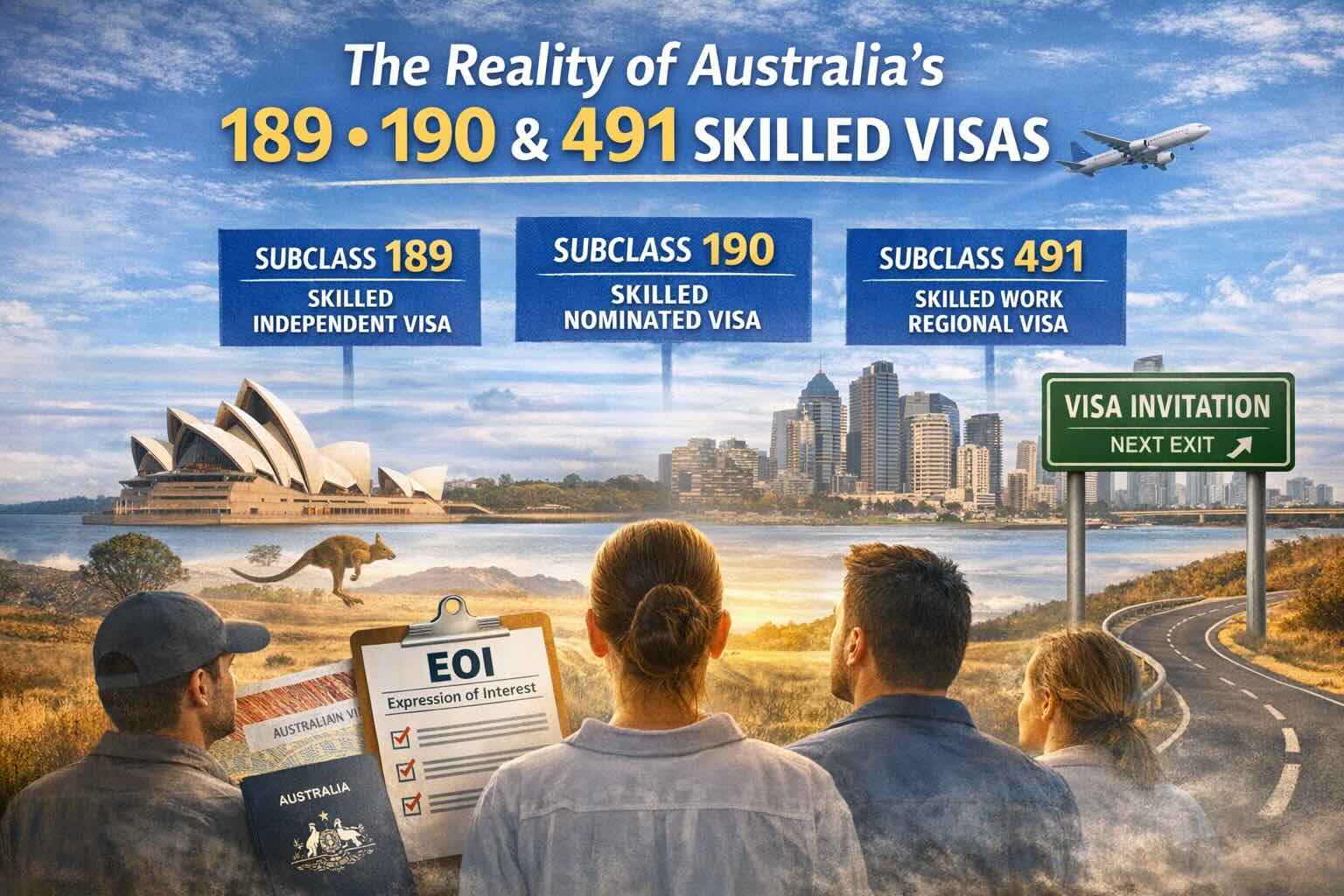
Every year, skilled migrants across Australia and offshore invest significant time and money into the skilled migration system. English language tests, skills assessments, NAATI accreditation and multiple Expressions of Interest are often completed with the belief that an invitation is simply a matter of time.
In practice, many applicants never receive one.
At Heenan & Browne Visa Migration Services, we regularly assist clients in Canberra, Brisbane, Cairns, Sydney and Melbourne who meet the minimum points requirement yet remain in the SkillSelect pool for years. The most common issue is not eligibility, but misunderstanding how competitive the system has become.
Meeting the points threshold allows you to submit an Expression of Interest (EOI) via Skill Select. It does not mean you will be invited.
Australia’s General Skilled Migration program operates on a points-tested invitation model. You cannot apply for these visas directly. You must first receive an invitation from the Department of Home Affairs.
The Skilled Independent visa (subclass 189) is a permanent visa that does not require employer or state sponsorship. It is entirely invitation-based and is the most competitive skilled visa in Australia.
The Skilled Nominated visa (subclass 190) also provides permanent residence but requires nomination from a state or territory government. Applicants must meet both federal requirements and the specific criteria set by the nominating state.
The Skilled Work Regional visa (subclass 491) is a provisional visa valid for five years with a pathway to permanent residence. It requires state or territory nomination or sponsorship by an eligible family member in a designated regional area.
Across all three visas, scoring 65 points only makes you eligible to lodge an EOI. Invitations are issued to those who are competitive within their occupation and aligned with current government priorities.
One of the biggest misconceptions we see in our Sydney and Melbourne offices is the belief that points alone determine success. In reality, several other factors play a far greater role.
Each state and territory receives a limited number of nomination places every financial year. Once these places are filled, invitations stop, regardless of how strong an applicant’s profile may be.
Occupation demand also varies significantly. Some professions are actively targeted due to labour shortages, while others are oversupplied. This can change quickly and differs from state to state.
Points scores are another critical factor. While 65 points is the minimum, most invitations are issued at much higher scores. In many occupations, successful applicants are sitting well above 85 points.
Recent invitation trends highlight how uneven the system can be.
Construction trades and certain technical occupations have continued to receive invitations at relatively lower points due to workforce shortages. Health professionals, particularly nurses, remain in demand in many states. Teachers in specific subject areas are also prioritised in some jurisdictions.
By contrast, professions such as accounting, marketing, hospitality management, enrolled nursing and facilities management are highly competitive. Even applicants with strong qualifications and Australian experience may receive no invitations at all.
These outcomes are not a reflection of individual capability, but of broader migration planning and labour market demand.
Many applicants come to us after spending thousands of dollars on skills assessments, English tests, NAATI accreditation and repeated EOIs, only to discover that their occupation has little to no invitation prospects.
Before investing further, it is essential to understand your realistic chances under the current migration settings. This includes reviewing occupation ceilings, state nomination trends and whether skilled migration is the most suitable pathway for your circumstances.
Professional advice early in the process can prevent years of frustration and unnecessary expense.
For many skilled workers, employer-sponsored visas offer a more practical route to living and working in Australia.
Options such as the Skills in Demand visa (subclass 482), the Employer Nomination Scheme (subclass 186) and Designated Area Migration Agreements can provide clearer and more predictable pathways, particularly for occupations that are not receiving GSM invitations.
In regional areas such as Cairns and parts of Queensland, employer sponsorship opportunities can be more accessible due to local workforce needs.
While finding a sponsoring employer takes planning and the right strategy, it is often more achievable than waiting indefinitely for a SkillSelect invitation that may never arrive.
Heenan & Browne Visa Migration Services provides tailored migration advice grounded in current policy, real invitation data and practical outcomes. With offices in Canberra, Brisbane, Cairns, Sydney and Melbourne, we assist clients across Australia and internationally.
We focus on clarity, honesty and strategy, not assumptions or outdated migration myths.
If you are unsure whether the subclass 189, 190 or 491 visa is right for you, or whether another pathway may offer a better chance of success, speaking with a registered migration professional can make a significant difference.
Your migration journey deserves informed decisions and realistic guidance. If you would like help understanding your options, Heenan & Browne Visa Migration Services is here to assist. Book a consultation now.